For the average Filipino worker, “salary” is no longer just a figure on a contract, it has become a high-stakes game of survival.
A comprehensive social intelligence report released by Capstone Intel Corp., a high impact research company specializing in social intelligence and data analytics, reveals that the digital conversation surrounding compensation is dominated by “lived financial pressure.” Filipinos are increasingly vocal about the shrinking value of their “take-home pay” as inflation and mandatory deductions eat away at their monthly earnings.
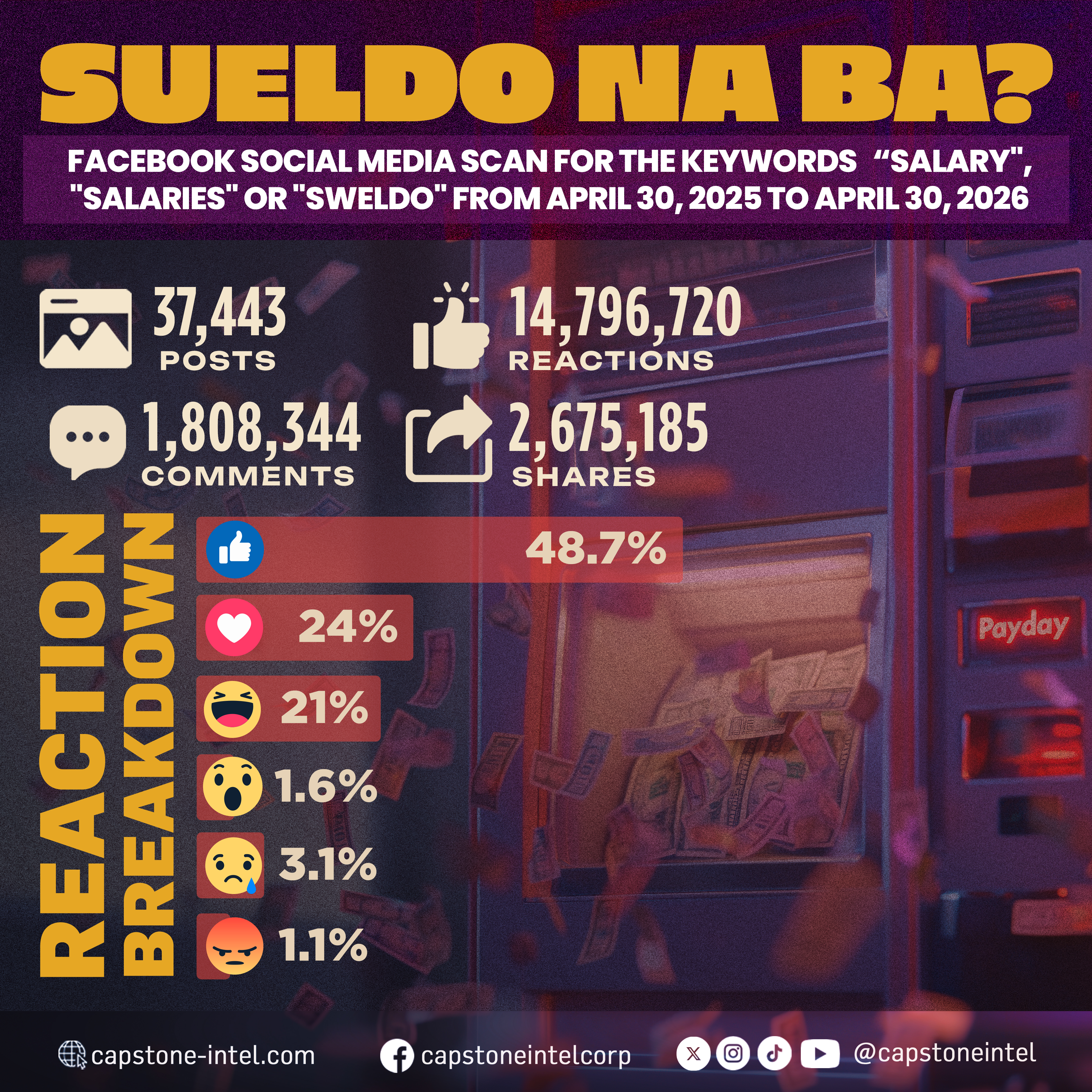
The study, which scanned Facebook activities from April 30, 2025, to April 30, 2026, analyzed a massive dataset of 37,443 posts that generated over 14.7 million reactions, 1.8 million comments, and 2.6 million shares. With a total social engagement score of 4.3 million, the data confirms that salary is the most sensitive topic for Filipino netizens today.
The data shows that Filipinos are no longer focused on “gross salary” but on what actually remains in their pockets after the “invisible hands” of deductions and loans take their share.
The most viral topic of the year was the proposal to suspend mandatory deductions (SSS, GSIS, PhilHealth, and Pag-IBIG) during the energy crisis. This single narrative, highlighted by a NewsWatch Plus Philippines post, garnered a massive engagement score of 127,457.4.
“The data reveals a stark reality: salary is now viewed strictly through the lens of household survival,” says Ella Kristina Domingo, Head of Data Analytics at Capstone Intel Corp. “For those in Classes C, D, and E, the conversation isn’t about career growth; it’s about how much is left after loans and deductions are sliced off. Filipinos are monitoring their ‘buying power’ in real-time, reacting most strongly when their immediate cash flow is threatened or offered relief.”
Capstone categorized the discourse into high-impact “issue buckets” that reflect the true pulse of the people:
The largest portion of the conversation (1.2 million engagement score) focused on making ends meet, utility bills, and “payday humor” used to mask financial anxiety.
Teacher & Education Worker Pay (13.7% share): This sector remains a sentimental favorite, with the public showing strong support (596,148.2 engagement) for educators who are perceived as overworked and underpaid.
Government Accountability (13.2% share): This bucket saw a high concentration of “Haha” reactions (21% of total reactions). Netizens used sarcasm to mock officials receiving high salaries despite poor performance or frequent absences.
Wage Hikes & Cost of Living (10.1% share): Calls for salary increases are now permanently linked to the prices of fuel, rice, and medicine.
The emotional response of Filipinos is a unique mix of hope and cynicism. While 48.7% (7.2 million) of reactions were “Likes” and 24% (3.5 million) were “Love,” a significant 21% (3.1 million) were “Haha.”
According to Capstone, this high level of satire serves as a “coping mechanism”. Filipinos laugh at their financial struggles while simultaneously using humor to criticize systems they feel are unfair.
The report also noted high engagement for personalities like Vico Sotto (101,519.8 engagement) and Raffy Tulfo (97,936.6 engagement) when discussing wage equality and public accountability. This proves that the public is hungry for narratives that champion worker dignity and regional wage fairness.
“The message from the public is clear: a worker’s dignity is tied to a wage that can actually support a family,” Domingo added. “Technical economic explanations are no longer enough. People are looking for ‘take-home pay’ relief that is felt at the grocery store and ‘deduction holidays’ that are felt in the wallet.”
Capstone Intel Corp. warns that policymakers must pivot toward “net pay” narratives. The recurring “sweldo is not enough” storyline is more than just a
complaint, it is a collective call for a more humane compensation system and the protection of essential benefits like the 13th and 14th-month pay.
Capstone-Intel’s Social Listening service provide real-time awareness of online conversations and media narratives for proactive communication and decision-making.

Capstone-Intel Research Team
The Research Team at Capstone-Intel Corporation delivers data-driven insights on public sentiment, emerging trends, and societal issues to help organizations and communities make informed decisions.