SONA Conversation Shows Public Wants Proof, Priorities and Results
Updated August 13, 2026 Capstone-Intel Corporation’s social monitoring data five days after show that President Ferdinand Marcos Jr.’s 2026 State of the Nation Address drew massive attention, but many Filipinos responded with ridicule, doubt…
By Capstone-Intel Research TeamAugust 4, 20264 min read
Updated August 13, 2026
Capstone-Intel Corporation’s social monitoring data five days after show that President Ferdinand Marcos Jr.’s 2026 State of the Nation Address drew massive attention, but many Filipinos responded with ridicule, doubt and demands for measurable results.
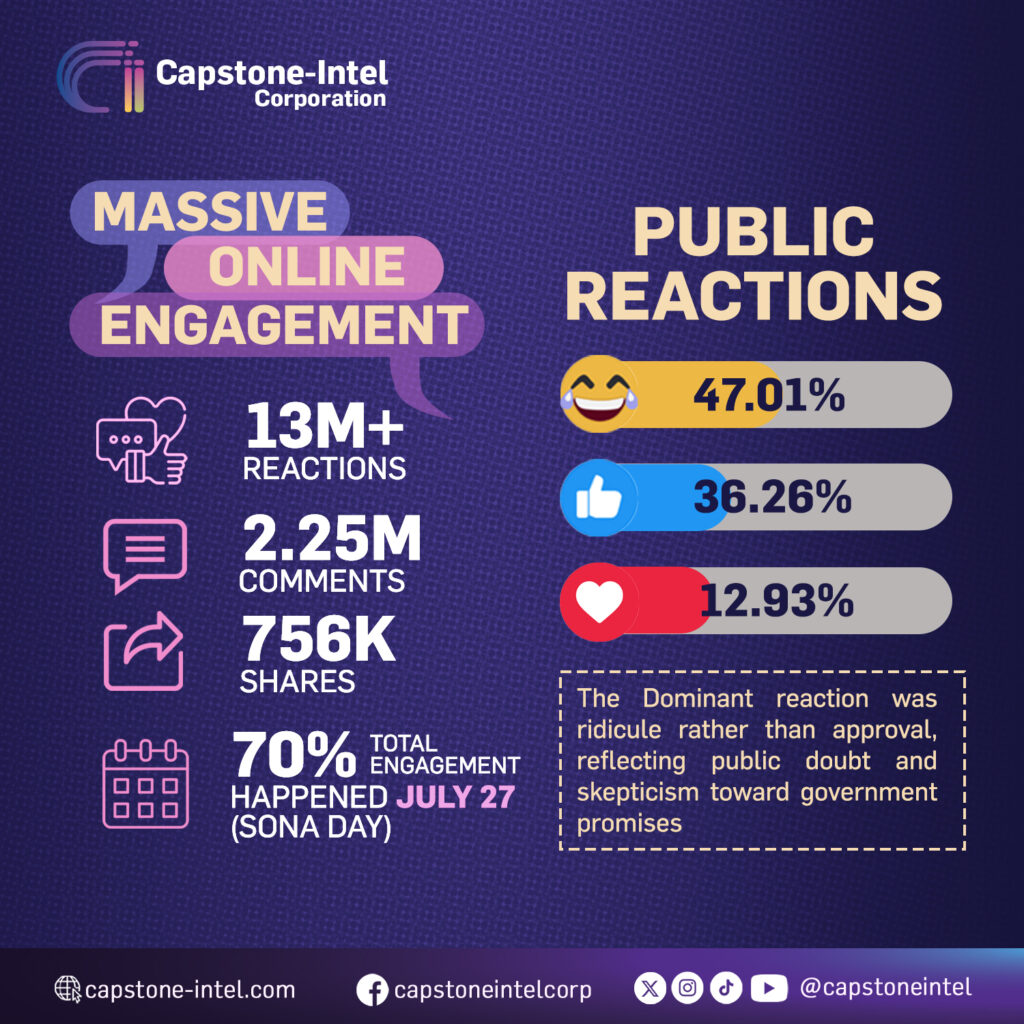
The result showed that “Haha” was the leading Facebook reaction to SONA-related posts. It accounted for 47.01 percent of all reactions, higher than “Like” at 36.26 percent and “Love” at 12.93 percent.
The reaction pattern suggests that ridicule, disbelief and political spectacle strongly influenced the public conversation. Many users did not simply discuss the President’s announcements. They questioned whether the administration could turn its promises into visible improvements in people’s daily lives.
The monitored Facebook posts generated more than 13 million reactions, 2.25 million comments and 756,000 shares. Almost 70 percent of the total engagement happened on July 27, the day of the speech.
Despite the high numbers, online attention quickly declined after the SONA. This creates a major challenge for the administration: announcements may dominate the news for one day, but public confidence will depend on what happens afterward.
Capstone-Intel Corporation Chief Executive Officer Geraldine Brillantes said the government must provide the public with a clear and continuing record of its work.
“A national address should not end with promises and applause. The government must present a concrete record of accomplishments, regular progress updates and verifiable proof that programs are being implemented. People need to see what was completed, what remains delayed, how much was spent and who is responsible for delivering the results,” Brillantes said.
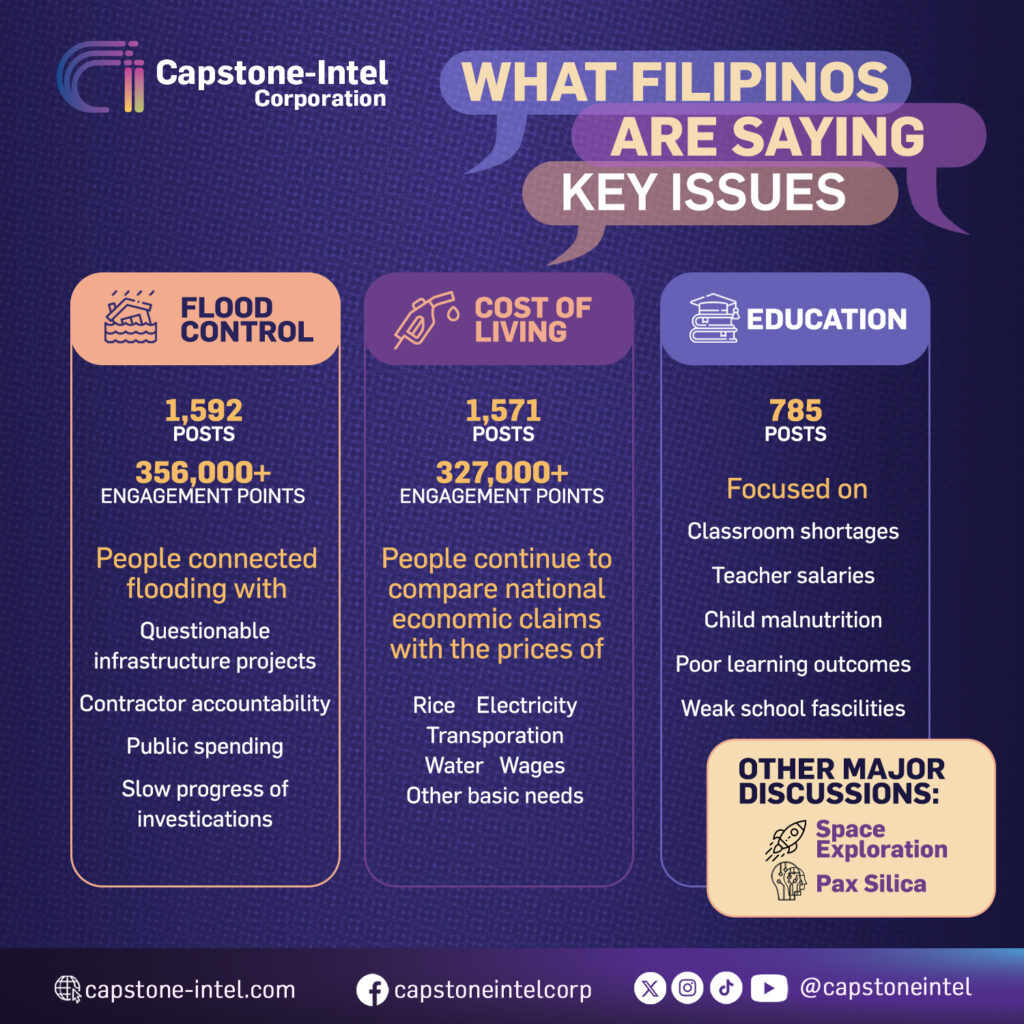
Flood control emerged as one of the strongest issues in the conversation. It appeared in 1,592 Facebook posts and generated a combined engagement score of more than 356,000.
Users connected flooding with questionable infrastructure projects, contractor accountability, public spending and the slow progress of investigations. For affected families, flood control is not merely a technical or political issue. Flooding destroys homes, suspends classes, disrupts work and puts lives at risk.
The government must publish clear information on flood-control projects, including their locations, contractors, budgets, completion status and inspection results. It must also explain what actions it has taken against failed, delayed or substandard projects.
Cost of living was another major concern. Discussions about prices, wages and household expenses appeared in 1,571 Facebook posts and generated an engagement score of more than 327,000.
People continued to compare national economic claims with the prices of rice, electricity, transportation, water and other basic needs. Growth figures may appear positive, but families measure progress through their ability to pay bills, buy food and send children to school.
Capstone-Intel Research Director Ella Kristina Domingo said the government must prioritize programs according to their direct impact on ordinary Filipinos.
“Government priorities must reflect the most urgent needs of the people. Projects should not be judged only by how ambitious or modern they sound. They should be measured by their actual impact—whether they reduce household expenses, create stable jobs, improve public services, protect communities and make daily life better,” Domingo said.
The government’s promotion of Pax Silica and its proposed space and rocket initiatives also attracted attention and criticism. Some users questioned why the administration highlighted advanced technology projects while schools lacked classrooms, teachers demanded better pay and communities continued to experience flooding and unreliable services.
These initiatives may offer long-term opportunities, but the government must clearly explain their cost, timeline and public benefit. It must also show that these projects will not take resources away from urgent concerns.
Education appeared in 785 Facebook posts. Much of the discussion focused on classroom shortages, teacher salaries, child malnutrition, poor learning outcomes and weak school facilities.
Broad statements about improving education will not be enough. The administration must release funded targets, implementation schedules and measurable outcomes.
Political spectacle also competed with policy issues. Posts about absences, family conflicts, outfits and political personalities gained strong engagement. The most engaging posts often focused on controversy rather than government programs.
The monitoring also recorded 8,841 mentions from online news, Facebook, X, videos, TikTok, Instagram, blogs and other platforms. Many were classified as neutral because they reported or reposted information. However, neutral reporting should not be treated as public support.
The strongest message from the online conversation is clear: Filipinos want evidence.
They want lower prices, reliable public services, safe schools, effective flood protection, better jobs and accountability for failed projects. They also want regular updates that allow them to compare government promises with actual performance.
The SONA presented the administration’s plans. The next step is to show the public the proof.
The Research Team at Capstone-Intel Corporation delivers data-driven insights on public sentiment, emerging trends, and societal issues to help organizations and communities make informed decisions.