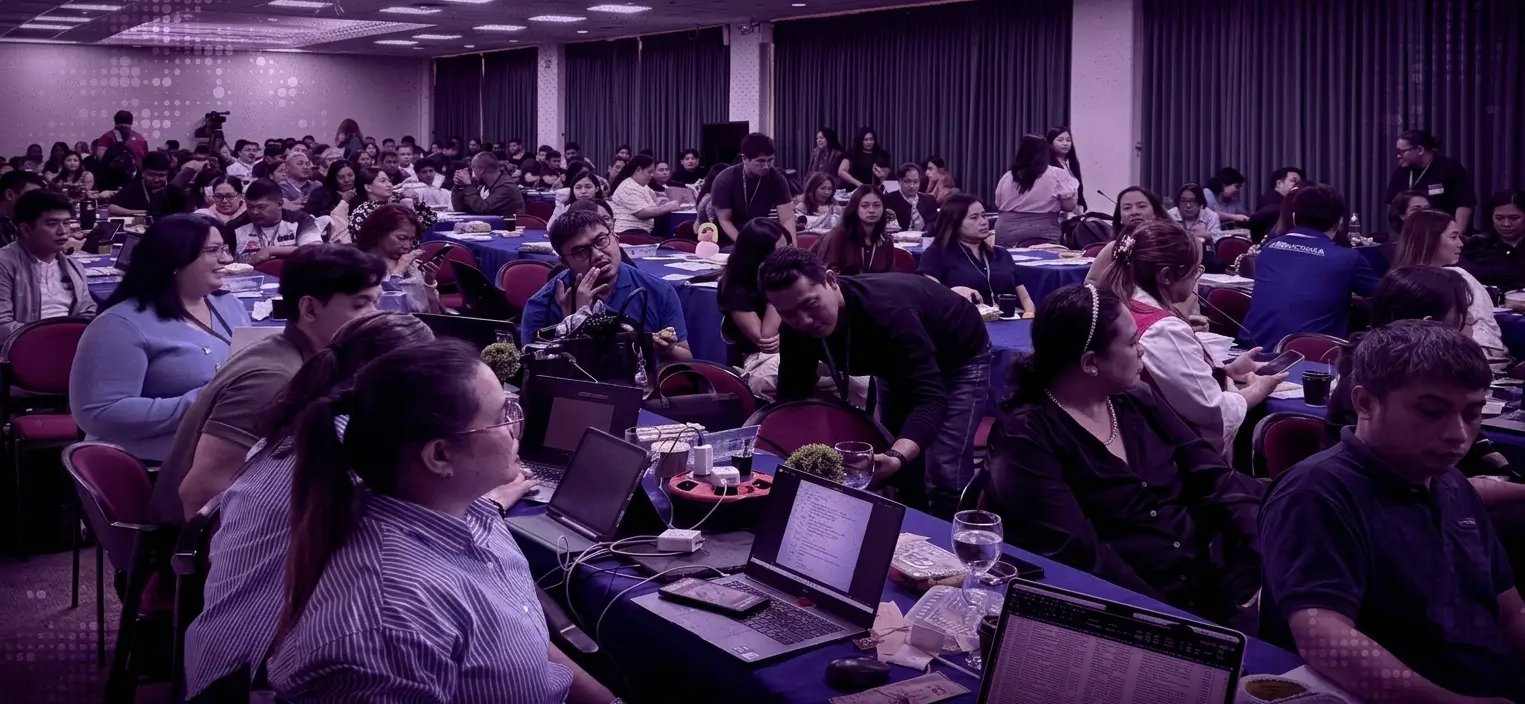
When the House of Representatives wanted to train its own staff on crisis communication, they didn’t just bring in a trainer — they asked for the data first.
On June 16, 2026, roughly 200 congressional staff, political affairs officers, communications officers, and chiefs of staff filled Speaker Belmonte Hall at the House of Representatives in Quezon City for a full-day training: Strengthening Strategic Communication for Congressional Staff: Crisis Communication and Social Media Management.
It was organized jointly by CONSA (the Congressional Staff Association), CONCOM (the Congressional Communicators Association), ILLG (the Institute for Legislation and Legislative Governance), Capstone-Intel Corporation, and JTI Philippines — and by CONSA’s own account, it was a milestone: the association’s first fully partnered activity, and the first seminar of its kind held within Congress.
This training is a real-world example of what our Training & Workshops Services actually look like in practice.
WHY THIS TRAINING HAPPENED
The event responded to a specific, fast-moving problem: a rapidly evolving information environment marked by misinformation, coordinated digital attacks, and the growing influence of AI in public discourse. The goal was practical — equip congressional communicators with tools to plan strategically, build evidence-based content, manage a crisis in real time, and use AI as a tool rather than a threat.
As Executive Director Atty. Gian Jordan Lucas put it in his opening remarks on behalf of Speaker Faustino G. Dy III, the task of a communications officer isn’t to manufacture a story — it’s to tell the one that already exists: laws that help families, oversight that improves governance, public servants working quietly to solve problems.
THE DATA THAT OPENED THE TRAINING
Before any communication strategy was taught, participants saw the numbers. Capstone-Intel’s own social listening team presented a year of Facebook monitoring on the keyword “House of Representatives” (June 2025 to June 2026):
- 6.71 million total engagement score across the top 10,000 most-engaging posts
- 34 million reactions, 7 million comments, 2.6 million shares
- An average of 277.5 posts per day, averaging 671 engagements per post
- Dominant reaction: “Haha” at 43.49%, ahead of “Like” at 33.09%
That last figure is worth sitting with. It’s an independent data point that echoes what our own analysis has shown before: a high “Haha” share on institutional content isn’t usually humor — it’s public skepticism. In this case, the finding was blunt: the public often treats House proceedings as spectacle rather than substance.
The top engagement themes reinforced the same picture: institutional credibility (23%), flood control (18%), and budget, education, and social services (12.4%) — with a clear warning that overly defensive messaging tends to increase public ridicule, while factual, process-centered communication performs better.
WHAT THE FIVE MODULES COVERED
- Module 1 — Research and Strategic Communication (Kaye Domingo, Capstone-Intel): the Four Phases of Strategic Communication, and the “Message House” framework — an umbrella statement, three to four core pillars, and proof/evidence tying it together.
- Module 2 — Writing for Mainstream and Social Media (Melvin Gascon, journalist): the 80-20 rule for congressional communication — 80% of effort on constituency-level communication, 20% on national visibility — plus a hard rule on crisis writing: what do we know, what are we doing, what are we not yet confirming, what happens next.
- Module 3 — Social Media Content Creation in 2026 (Karl Domingo, Capstone-Intel): the “2-3 second rule” for content hooks, and why short-form vertical video now dominates algorithmic reach.
- Module 4 — AI Technologies in Crisis Communication (Dr. Donald Patrick Lim, Management Association of the Philippines): a four-stage crisis model — Spark, Amplify, Lock-In, Escalate — that can unfold in under an hour. Dr. Lim’s warning to the room: “the next political battlefield in the Philippines will be deepfakes… the competition will shift from online noise to who creates the most believable synthetic content.”
- Module 5 — Crisis Communication Playbook (Estrella Torres, Capstone-Intel): a three-part response plan — Evidence, Content, and Media — built around a clear decision hierarchy so a crisis response doesn’t stall waiting for sign-off.
TYING IT TOGETHER
Capstone-Intel COO Geraldine Torres Brillantes — a political strategist with three decades of experience and author of the five-volume Election Game Changer series — led the synthesis session, translating the day’s modules into a concrete structure: every congressional office, she argued, needs three layered plans — an overall strategic plan, a communications plan within it, and a crisis plan as a subset of that.
Her closing message to the room: “The strongest crisis response is not a clever statement — it is years of earned trust, visible service, and authentic connection with people.”
Participants then worked in ten groups of roughly twenty, building real Message House frameworks and crisis protocols for two live institutional issues — accountability in the impeachment process, and transparency in the budget process — presenting their outputs to the full room before closing ceremonies.
Why this matters
This training is a useful case study for exactly the “Value for Policy Makers” case we’ve made about social listening: an institution didn’t just want a communications workshop — it wanted one grounded in real data about how it’s actually perceived. The finding that nearly half of all Facebook reactions to House content are “Haha” isn’t a criticism buried in a report; it became the opening data point of a training designed to change that.
Capstone-Intel regularly partners with government offices and institutions on strategic communication training grounded in real audience data. See our Training & Workshops Services or Social Listening Services to learn more.
Frequently Asked Questions
Was this training specific to one political party or office? No — it was organized for congressional staff broadly, through CONSA and CONCOM, with participants from multiple congressional offices.
What made the “Haha” reaction finding significant? A 43.49% share of “Haha” reactions on institutional content is a strong signal of public skepticism, not humor — consistent with broader patterns we’ve documented in how Filipino Facebook users react to institutional and economic content they view with doubt.
Is this kind of training available to other government offices or organizations? Yes — this event is representative of what Capstone-Intel’s Training & Workshops Services offer, particularly the Strategic Communication Planning Workshop track.
Did participants receive certification?
Yes — CSC-validated Certificates of Participation were issued upon completion of all training requirements, including pre- and post-tests and an evaluation form.